Can Ayurveda Help With Avascular Necrosis? An Honest Look at Stages and Options
Avascular necrosis (AVN) often starts quietly. By the time hip pain is hard to ignore, many people have already been told they may need surgery, and many start asking whether Ayurveda can help. The honest answer is that it may help some people with pain and movement, but it depends on the stage of the bone damage, and the research is still limited. This article explains where Ayurvedic care may fit, and where it does not.
What AVN Is, and Why the Stage Matters
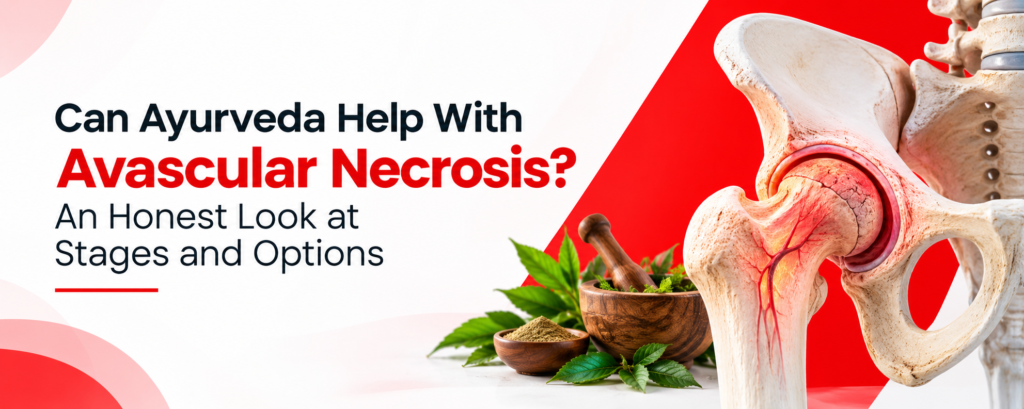
AVN is the death of bone tissue caused by a loss of blood supply. It can lead to tiny breaks in the bone and, over months to years, to collapse of the joint surface. The hip is affected most often, but the knee, shoulder, ankle and hand can also be involved. Common triggers include a fracture or dislocation, long-term high-dose steroid use and heavy alcohol intake.
Early AVN may cause no symptoms at all. Later, pain appears with weight-bearing and eventually at rest, often in the groin, thigh or buttock. Plain X-rays can look normal in the early stages, while an MRI can pick up changes sooner.
The key question is whether the bone has collapsed. Before collapse, the aim is to protect the joint and slow further damage. After collapse, the focus shifts to restoring function, and joint replacement may come into the conversation.
How Ayurveda Approaches AVN
Classical Ayurvedic texts do not use the term AVN. Practitioners usually compare its symptoms to Asthi-Majjagata Vata, a disorder involving bone tissue and marrow. Published case reports describe Panchakarma-based programmes that combine therapies such as oil massage (Abhyanga), herbal poultices, sudation and medicated enemas (Basti) with internal medicines and rejuvenating (Rasayana) treatment, sometimes with physiotherapy exercises.
In practice, a programme is personalised. Therapies are chosen after the doctor reviews your reports, given under supervision over a set number of days, and followed by medicines and a diet and exercise plan for home. Follow-up depends on how you respond. A repeat X-ray or other test at the end of the programme gives a more objective comparison than how you feel on the day.
What the Evidence Shows, and What It Doesn't
The published evidence on Ayurveda for AVN is made up mostly of individual case reports. Several describe less pain, better hip movement and improved walking after treatment. One report on bilateral hip AVN described imaging regression at about 23 months of follow-up, though its authors say further studies are needed.
These are single patients without comparison groups. They show that some people improved, not that Ayurvedic care reliably stops bone collapse. Nor do they show that it can replace conventional options such as core decompression, which is generally used in the earlier stages, or joint replacement after collapse. Larger, controlled studies would be needed to answer that question.
Which Stages May Suit Ayurvedic Care?
Only a doctor who has seen your scans can answer this for you. In general terms:
- Before collapse: this is the window where joint-preserving care has the most to offer. Some patients choose Ayurvedic treatment for pain and mobility here, alongside reduced weight-bearing on the joint.
- After collapse: Ayurvedic therapy may still ease pain and stiffness, but there is no good evidence that it rebuilds a collapsed joint surface. If the joint is badly damaged, an orthopaedic opinion on replacement is worth having.
- Both hips or several joints: AVN can affect more than one joint, so each one needs to be staged separately.
Why MRI Reports and a Doctor's Assessment Come First
Any treatment plan for AVN should start with imaging. An MRI shows the stage and how much of the bone is involved, and it can reveal changes in the other hip that you have not felt yet. Without it, nobody can tell you honestly what to expect.
At Dr. Vijay Prakash’s clinic, patients are asked to bring their MRI, X-ray and other reports, and suitability for Ayurvedic treatment is decided by the doctor according to the stage of the condition. If travel is difficult, an initial review of your reports is also possible by tele-consultation.
Outside of an emergency, it’s worth booking a neurology consultation if your headaches happen more than four times a month, wake you from sleep, have changed in pattern recently, no longer respond to over-the-counter medication, or if you find yourself needing pain medication more than ten days a month. A neurologist can take a detailed history of your headache pattern, examine you, and confirm whether you’re dealing with migraine, tension headache, or something else, so your treatment is based on an accurate diagnosis rather than trial and error.
Frequently Asked Questions
Can Ayurveda cure AVN?
No treatment can promise a cure. Case reports describe improvement in pain and movement after Panchakarma-based care, but results vary with the stage of the condition and the person.
Can AVN be treated without surgery?
In the early stages, non-surgical measures such as medication for symptoms and reduced weight-bearing are often tried first. Once the bone has collapsed, surgery is more often needed. Your specialist can advise based on your MRI.
Is an MRI necessary before starting Ayurvedic treatment?
It is strongly advisable. Early AVN can be missed on X-ray, and the MRI shows the stage that guides every decision.
Which stage responds best to Ayurvedic care?
There are no controlled studies to say. Options are generally wider before the bone collapses, but the doctor’s assessment of your scans should decide.
Can I take Ayurvedic treatment along with my current medicines?
Do not stop any prescribed medicine on your own. Inform both your Ayurvedic doctor and your other doctors about everything you are taking.
Can I consult remotely?
Yes. Dr. Vijay Prakash’s clinic offers tele and video consultation. Reports can be shared on WhatsApp at 7007968664 before a slot is allotted.
Talk to an Ayurvedic AVN Specialist
If you have an MRI or X-ray report and want to know whether Ayurvedic care may suit your stage of AVN, you can share your reports with Dr. Vijay Prakash’s team on WhatsApp at 7007968664, or call 7007968664 / 9151736092. The doctor will review them before advising you on the next step.
Doctor Bio / Medical Reviewer
Dr. Vijay Prakash (MS CRRA, BAMS, CTY, DY) is the founder of ANHRC (Saubhagya Ayurvedic Neuro & Panchakarma Hospital & Research Centre) in Kanpur, established in 2012, and specialises in AVN, spine and joint-related problems. He completed his BAMS at Rishikul Government Ayurvedic College, Haridwar, and his MS CRRA at Sikkim Manipal University. He is registered with the Board of Ayurvedic and Unani Tibbi System of Medicine, U.P.